



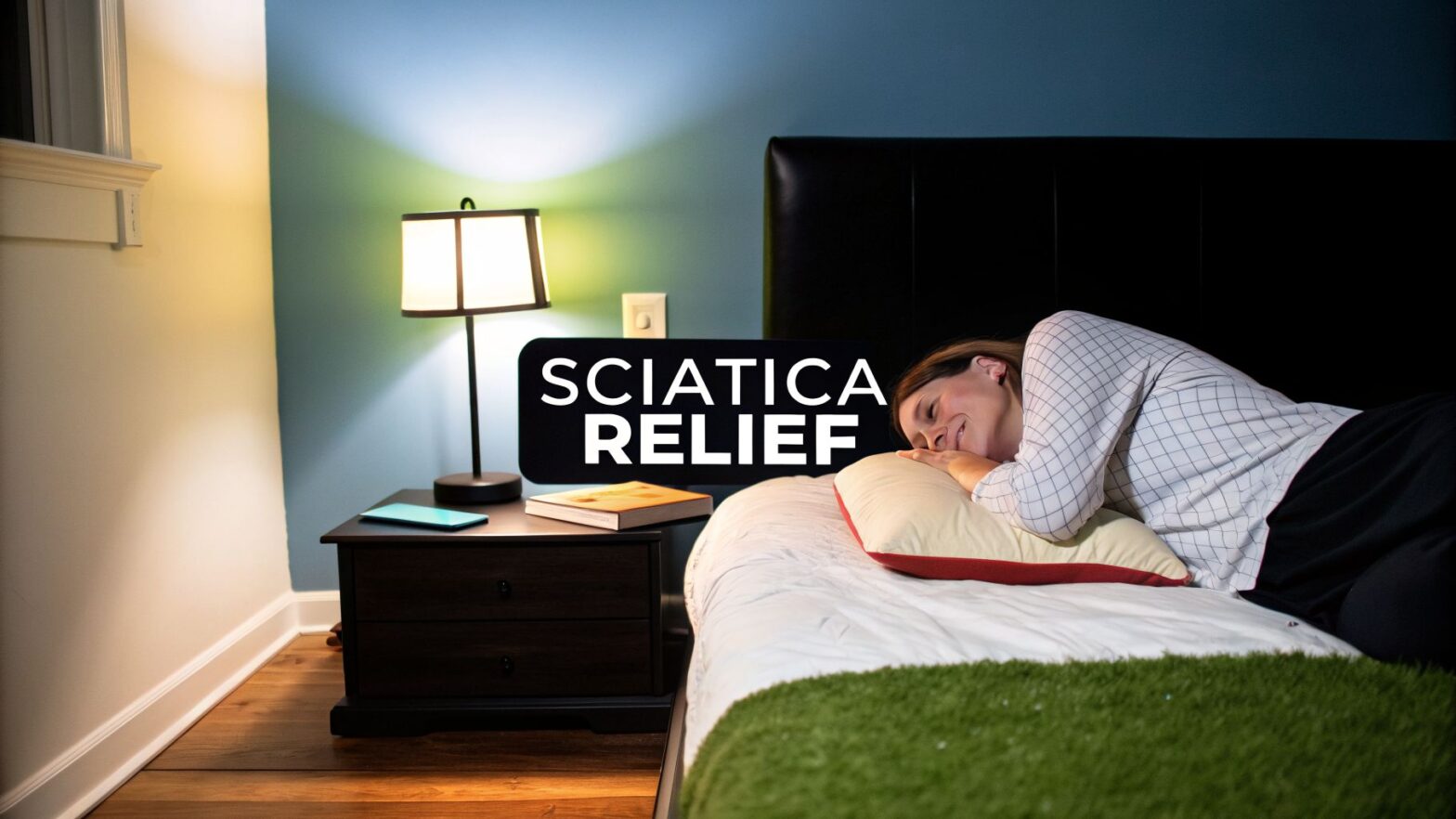
If that sharp, radiating pain shooting down your leg is keeping you up at night, you know how maddening sciatica can be. It’s a frustrating cycle: the pain ruins your sleep, and the lack of sleep makes the pain feel even worse. For many of our patients at Resolve Chiropractic here in San Jose, CA, finding a way to get comfortable at night is the first, most urgent priority.
Often, the first step toward breaking that cycle is surprisingly simple—it all comes down to how you’re sleeping. This guide is meant to give you practical advice from a local chiropractor who understands what you're going through.
Your San Jose Chiropractor's Guide to Sleeping with Sciatica

When sciatic nerve pain flares up, trying to get comfortable in bed can feel like an impossible task. The moment you lie down, that familiar ache, tingling, or numbness seems to intensify, running from your lower back all the way down your leg. Here in San Jose, California, this is one of the most common complaints we hear from patients at Resolve Chiropractic. You end up tossing and turning all night, only to wake up exhausted and dreading the next one.
This guide will give you practical, trusted advice on how to sleep with sciatica. We’ll get straight to the strategies that can bring you relief tonight. But more than that, as your local chiropractic team, we want to help you understand why these adjustments work, so you can take control of your symptoms for good.
So, What's Happening When Sciatica Wrecks Your Sleep?
Sleep is your body's prime time for healing and repair. When sciatica disrupts that crucial process, you don't just feel tired—your recovery can actually slow down. This is why your sleeping posture is so important. The wrong position can misalign your spine and put direct pressure on that already irritated sciatic nerve.
And you're far from alone in this struggle. Sciatica is incredibly common, affecting anywhere from 1.2% to 43% of people at some point in their lives. The good news? Research shows that simple changes, like lying on your pain-free side with a pillow between your knees, can reduce sciatic nerve pressure by 30-50% during an acute flare-up.
That reduction in pressure isn't just about comfort. It allows your body to enter the deep REM sleep cycles essential for healing tissue and calming pain signals. In fact, many patients report a 70% improvement in their sleep quality after just a few weeks of consistent positioning and gentle stretches. For a deeper dive into the numbers, you can review the full sciatica epidemiology research.
At Resolve Chiropractic, we see it every day: better sleep accelerates healing. When you give your body a neutral, supported position at night, you’re giving your nervous system the break it needs to calm down and recover.
Finding a San Jose Chiropractor Who Gets It
While optimizing your sleep is a huge first step, it’s usually treating the symptom, not the source. The pain you feel is an alarm bell from your body, signaling that something in your lower back—a herniated disc, a spinal misalignment, or a tight muscle—is compressing the sciatic nerve.
That's why working with a skilled sciatica chiropractor in San Jose can be a game-changer. At Resolve Chiropractic, our doctors use the Gonstead method, a highly precise technique for pinpointing the exact cause of nerve interference. We don’t just want to help you manage the pain night after night. Our goal is to correct the underlying structural issue so you can find lasting relief and get back to living without the fear of another sleepless night.
Think of this guide as your starting point for immediate comfort. Our clinic is your local resource for long-term healing.
Of all the complaints we hear about sciatica from our patients, the most frustrating for people is often how it seems to get worse at night. You’ve been on your feet all day, you finally lie down hoping for some relief, and then—bam. That sharp, radiating pain down your leg flares up, sometimes worse than it was all day.
If this sounds familiar, we want to reassure you, it’s not just in your head. There are very real physical reasons why your sciatic nerve pain loves to ramp up the moment you get into bed.
When you’re standing or walking, gravity is doing its thing, keeping your spine and the discs between your vertebrae slightly compressed. As soon as you lie down, that pressure lets up. You’d think that would be a good thing, right? But for someone with a bulging or herniated disc, this decompression can allow the disc to shift, sometimes pressing even more directly onto the sciatic nerve root.
It’s a bit like a tire with a slow leak that's been propped against a wall. As the tire deflates, it bulges out in new places, potentially pushing harder against the wall. That’s what can happen to your disc at night, and it’s a story we hear all the time from our patients here in San Jose.
What’s Really Pinching Your Sciatic Nerve?
Sciatica isn't a diagnosis in itself; it's a symptom. It’s the name for the pain that happens when your sciatic nerve—the longest nerve in your body, running from your lower back all the way down your leg—gets pinched or irritated. To find lasting relief, we have to figure out what's causing that compression.
As a chiropractor in San Jose, we see a few common culprits behind that nerve pressure:
- Herniated or Bulging Discs: This is the big one. Your spinal discs are like little jelly donuts that cushion your vertebrae. When one gets damaged, the "jelly" inside can bulge out and press right on a nerve root, causing sciatica and back pain.
- Spinal Stenosis: Think of this as a narrowing of the canal your spinal cord runs through. As we age, bony growths or thickened ligaments can slowly shrink that space, leaving less room for the nerves.
- Piriformis Syndrome: This one is a bit of a sneaky imposter. The piriformis is a small muscle deep in your glutes, and the sciatic nerve often runs directly underneath it (and for some people, right through it). If that muscle gets tight or goes into spasm, it can squeeze the nerve and cause classic sciatica symptoms.
Sciatica is incredibly common, with a peak incidence between ages 40 and 59. What’s concerning is that many people don't know how to manage it effectively. A 2022 study revealed that a huge number of sciatica sufferers aren't aware of the best self-care strategies, which often leads to habits that make things worse—like sleeping in the wrong position. For example, we know that stomach sleeping is a major problem for nearly 40% of people who also have low back pain. You can dig into the research on sciatica prevalence and patient awareness here.
How Your Body’s Nightly Rhythm Can Make Pain Worse
It's not just about the mechanics of your spine. Your body's own internal clock and chemistry can also conspire to make your nights miserable.
As your body winds down for sleep, it naturally produces less cortisol, which is a powerful anti-inflammatory hormone. With less cortisol circulating, the inflammation around your irritated sciatic nerve can tick up a notch, making the pain feel more intense and raw.
Lying still for hours also means reduced blood flow and circulation. This can cause the muscles and tissues around the nerve to get stiff and sensitive, turning what was a dull ache into a sharp, throbbing pain that jolts you awake.
This is why just fluffing your pillows often isn't enough. If the root cause is a misaligned spine or a disc that’s out of place, that nerve will stay angry. That's where a sciatica chiropractor can make a real difference. By figuring out exactly what’s causing the compression, we can use targeted adjustments to restore proper spinal alignment and, most importantly, take the pressure off the nerve. For our patients here in San Jose, CA, this is the key to finally breaking that cycle of nightly pain and getting the deep, restorative sleep they desperately need.
The Best Pillow Setups and Sleep Positions for Sciatica
Trying to find a comfortable sleeping position when that searing sciatic pain strikes can feel impossible. It’s a frustrating puzzle, but the answer isn't about finding one "perfect" position. It's about making small, strategic adjustments to support your body. The entire goal is to maintain a neutral spine—keeping your head, neck, and back in a straight line to take pressure off that aggravated sciatic nerve.
This infographic shows the simple chain reaction that leads to those painful nighttime flare-ups.

As you can see, it often starts with pressure on a spinal disc, which then irritates the nerve. That irritation is what wakes you up in pain. This is exactly why a supportive posture during sleep is so critical—it can break that cycle.
Sleeping On Your Unaffected Side
For many of our sciatica patients in San Jose, this is the position that brings the quickest relief. It makes sense: by lying on the side that doesn't hurt, you're using gravity to your advantage instead of letting it press down on the already compressed nerve.
But just flopping onto your side isn't enough. The magic is in the pillow placement.
- Slide a firm pillow between your knees and ankles. This is non-negotiable. It stops your top leg from sliding forward, which prevents your hips and lower back from twisting and putting more strain on the nerve.
- Make sure the pillow is thick enough. A flimsy pillow won't do the trick. You need enough loft to keep your hips perfectly level. If your top hip dips down, you're still misaligning your spine.
- Try a small, rolled-up towel under your waist. This little trick fills the gap between your side and the mattress, giving your spine that extra bit of support to stay straight.
Sleeping On Your Back With Knees Elevated
Sleeping on your back is great for distributing your weight evenly and avoiding pressure points. The problem is that lying flat can cause your lower back to arch, which only makes sciatica worse. The fix is simple: elevation.
Grab a couple of pillows or a dedicated wedge pillow and place them under your knees. You want your knees to be gently bent. This simple move flattens your lower back toward the mattress, achieving two important things:
- It relaxes your hip flexors, a group of muscles that can tug on your lumbar spine when they get tight.
- It helps open up the small bony channels where nerve roots exit the spine, giving your sciatic nerve a bit more breathing room.
Your goal is to create a gentle slope from your hips down to your feet. When you get the height just right, you should feel the tension in your lower back melt away almost instantly. This is a go-to recommendation for our back pain chiropractor patients in San Jose, CA.
Adopting a Modified Fetal Position
If your sciatica is from a condition like spinal stenosis, curling up slightly can bring immense relief. This position flexes the spine, which can create more space within the spinal canal and temporarily ease that nerve compression.
Lie on your pain-free side and gently pull your knees up toward your chest, but don't overdo it. You're aiming for a relaxed curl, not a tight cannonball. Stop when you feel a sense of relief in your lower back. Many people find that hugging a body pillow helps them hold this position comfortably and stops them from twisting in their sleep.
Your Mattress Matters More Than You Think
Pillows are fantastic for immediate adjustments, but your mattress is the foundation for a truly restorative night. A mattress that’s too soft will let your hips and shoulders sink in, creating a painful "hammock" effect on your spine. On the other hand, one that's rock-hard won't accommodate your body's natural curves, leading to major pressure points.
For most people struggling with sciatica, a medium-firm mattress hits the sweet spot. It provides the support needed to keep your spine aligned while still having enough cushion for your joints. If a brand-new mattress isn't in the budget, a high-quality mattress topper can be a great, cost-effective solution to tweak the firmness.
If you are a patient at our San Jose chiropractic clinic, we can talk through your specific situation and figure out if your mattress is helping or hurting your recovery. Finding that right combination of sleep position, pillow setup, and mattress support is a huge step toward getting your sleep back and healing from sciatic nerve pain.
Your 15-Minute Routine to Quiet Sciatic Pain Before Bed

When you've been battling sciatic pain all day, just the thought of lying down can be stressful. You're already anticipating the sharp, radiating pain that seems to get worse the moment you get horizontal. What you do in the 15 minutes before you climb into bed can make all the difference.
Think of it as a wind-down ritual. The goal is to gently calm the tight muscles and frayed nerves that are causing all the trouble. For our patients here in San Jose, we've found a simple combination of gentle movement and targeted temperature therapy works wonders to prepare the body for a healing night's sleep.
Gently Unwind Tight Muscles
This isn't about a full workout; it's about gently coaxing your muscles to let go. Slow, controlled movements are key. If you feel any sharp or shooting pain, that's your body's signal to stop immediately.
Here are two stretches our chiropractors recommend to almost all of our patients dealing with sciatica:
Knee-to-Chest Hug: Lie on your back, knees bent, feet flat on the floor. Gently pull one knee towards your chest until you feel a comfortable stretch in your glute and lower back. Don't force it. Hold for about 20-30 seconds, breathing deeply, then slowly switch to the other side.
Seated Piriformis Stretch: Sit on the edge of a chair and cross the ankle of your painful leg over your other knee. Keeping your back straight, hinge forward at your hips. You should feel a deep stretch in your buttock—that’s the piriformis muscle, a notorious contributor to sciatica. Hold for 20-30 seconds before switching sides.
Doing these simple moves helps increase blood flow and release the tension that's been building all day. For a more comprehensive list of safe movements, check out our guide on the best exercises for sciatica relief.
The Heat vs. Ice Debate for Nighttime Relief
The "heat or ice" question is one of the most common things people ask. They both work, but they do completely different jobs. Knowing which one to grab can be a game-changer for your pre-bed routine.
To help you decide, here’s a quick breakdown:
Heat Therapy vs. Ice Therapy for Sciatica
| Therapy Type | Best For | How It Works | Application Tip |
|---|---|---|---|
| Heat | Chronic, achy muscle tightness and stiffness around the lower back. | Increases blood flow, relaxes muscles, and soothes general soreness. | Use a heating pad or take a warm bath for 15-20 minutes. Don't fall asleep on it! |
| Ice | Acute, sharp, burning pain or a sudden flare-up with inflammation. | Numbs the area, constricts blood vessels, and directly reduces swelling. | Wrap an ice pack in a towel and apply it to the most painful spot for 15 minutes max. |
Ultimately, let your body guide you. If your back muscles feel like a tight, knotted rope, heat is your friend. If the pain is sharp and feels "angry" or inflamed, reach for the ice.
Don't Forget to Calm Your Mind
Living with chronic pain is mentally exhausting. Your nervous system gets stuck in a high-alert, "fight or flight" mode, which makes it nearly impossible to relax and fall asleep.
A simple breathing exercise can work wonders to flip that switch. Before you get into bed, spend just two or three minutes on deep belly breathing.
Inhale slowly through your nose for a count of 4, feeling your belly rise. Then, exhale slowly through your mouth for a count of 6. This longer exhale tells your nervous system that it's safe to power down.
Here at Resolve Chiropractic in San Jose, we know that true healing involves more than just adjustments. By combining these simple pre-bed rituals with professional care from a sciatica chiropractor, you’re tackling the problem from all angles. You’re not just managing the pain—you’re setting the stage for real, restorative sleep.
How Gonstead Chiropractic in San Jose Offers Lasting Relief
While changing your sleep position and stretching before bed can definitely help you get through a tough night with sciatica, those are really just temporary fixes. They're fantastic coping mechanisms, but they don't solve the underlying problem.
Real, long-term relief comes from figuring out why your sciatic nerve is irritated in the first place and correcting it at the source. This is where targeted, professional chiropractic care comes in, and it can make all the difference.
At Resolve Chiropractic in San Jose, we don't guess when it comes to your health. We use a highly specific and analytical technique called the Gonstead Method to pinpoint the exact cause of your pain. We know you're not just a collection of symptoms; you're an individual, and your body needs a precise plan to heal correctly.
We Don't Just Treat Symptoms; We Find the Cause
Your first visit to our San Jose chiropractic clinic is a deep dive into the mechanics of your spine. Before we can fix a problem, we need to understand it completely. Our Gonstead analysis is a comprehensive process that outlines what patients can expect when visiting our clinic:
- X-ray Analysis: We start with full-spine X-rays taken while you're standing. This weight-bearing view gives us the full picture of your spinal structure, letting us see disc height, joint health, and any misalignments that could be putting pressure on your nerves.
- Instrumentation: We use a handheld instrument called a Nervoscope, which glides down your spine to detect tiny temperature variations. Inflammation around an irritated nerve gives off heat, and this tool helps us confirm the exact spot where the nerve interference is happening.
- Static and Motion Palpation: Our doctors use their hands to feel your spine, both while you’re still (static) and as you move through different ranges of motion (motion). This tactile feedback tells us exactly which joints are "stuck" or not moving as they should, confirming what we saw on the X-rays.
This detailed process means that every adjustment is delivered with precision. There's no guesswork involved—just a specific, targeted correction aimed right at the source of your sciatic nerve pain.
The Gonstead philosophy is simple but powerful: "Find the subluxation, accept it where you find it, correct it, and leave it alone." This means we only adjust the specific spinal segments that are causing the problem, which allows your body’s own healing intelligence to do the rest.
Benefits of Precise Adjustments for Sciatica
Once we’ve identified the root cause, we use gentle, specific adjustments to restore proper movement to the affected joints. By correcting the underlying misalignment, we take direct pressure off the sciatic nerve. Our goal isn't just to make you feel better for a day or two; it's to restore normal function so the pain stops coming back, improving your overall health and mobility.
This is a world away from general spinal manipulation. A Gonstead adjustment is calculated and specific, which is why it’s so effective for conditions like sciatica that often come from a very localized issue, such as a herniated disc or a disc injury. If you're exploring your options, you can learn more about our approach in our guide to the non-surgical treatment for sciatica.
Supportive Care for the San Jose Community
As your sciatica chiropractor in San Jose, we also believe in supporting the healing process. We may incorporate other chiropractic services, like spinal decompression or laser therapy, to help reduce inflammation and accelerate tissue repair, making your adjustments even more effective.
We're also passionate about serving everyone in our community, including expecting mothers. Sciatica is incredibly common during pregnancy, which is why we offer dedicated prenatal chiropractic care. Our office is equipped with Hi-Lo tables that safely accommodate a growing belly, allowing us to deliver comfortable adjustments throughout pregnancy to help mothers-to-be in San Jose have a more comfortable experience.
Ultimately, our mission is to get you back to living your life. By addressing the true cause of your sciatica, we can help you finally break the cycle of pain and sleepless nights.
What to Do When Temporary Fixes Aren’t Enough
So, you've tried adjusting your sleep position, you've got pillows tucked in all the right places, and you've even started a pre-bed routine to quiet that angry sciatic nerve. These are fantastic first steps for getting through the night when a flare-up hits.
But here’s the thing: managing pain isn't the same as healing from it. While these strategies offer much-needed relief, they're really just treating the symptom—the pain itself—not the source of the problem. Lasting relief only comes when you address what’s causing the nerve irritation in the first place.
The Difference Between Managing Pain and Correcting the Problem
We often use this analogy with our patients: if you have a rock in your shoe, you can learn to walk differently or wear thicker socks to lessen the pain. But you'll never truly walk comfortably until you take off the shoe and get the rock out.
Those sleep positions and stretches are your "thicker socks." They absolutely help, but the "rock"—that underlying spinal misalignment or disc issue—is still there. This is where getting professional care from a sciatica chiropractor in San Jose is no longer just an option, but a necessity for real recovery. Just managing the symptoms often leads to a frustrating cycle of pain, sleepless nights, and the feeling that it's never going to end.
You don't have to settle for a life dictated by sciatic pain. The goal isn't just to figure out how to sleep with sciatica—it's to get to a point where you don't have to think about it at all.
An Invitation to Our San Jose Community
For our neighbors here in San Jose, California, and the surrounding areas, we want to personally invite you to take that next step. At Resolve Chiropractic, our entire focus is on helping you move past the temporary fixes and onto a path of genuine, long-term healing. We've seen firsthand how identifying the precise cause of sciatica can completely change someone's life.
We also believe that getting great care shouldn't be complicated. To make it as straightforward as possible, our clinic is equipped to work with:
- PPO out-of-network plans
- HSA/FSA funds
- Personal injury liens for auto injury cases
Our team is always happy to run a complimentary benefits check to clarify your coverage before you even start. It’s time to stop just getting by and finally start getting better. Don't let another night of pain pass you by. Your journey back to comfortable, restorative sleep starts with a single decision. Let us show you how targeted, specific chiropractic care can help you not just manage your sciatica, but resolve it for good.
Are you ready to find the root cause of your pain and get back to the life you love? Resolve Chiropractic is the trusted chiropractor serving the San Jose community. Schedule your consultation today by visiting us online and begin your journey toward lasting relief.