



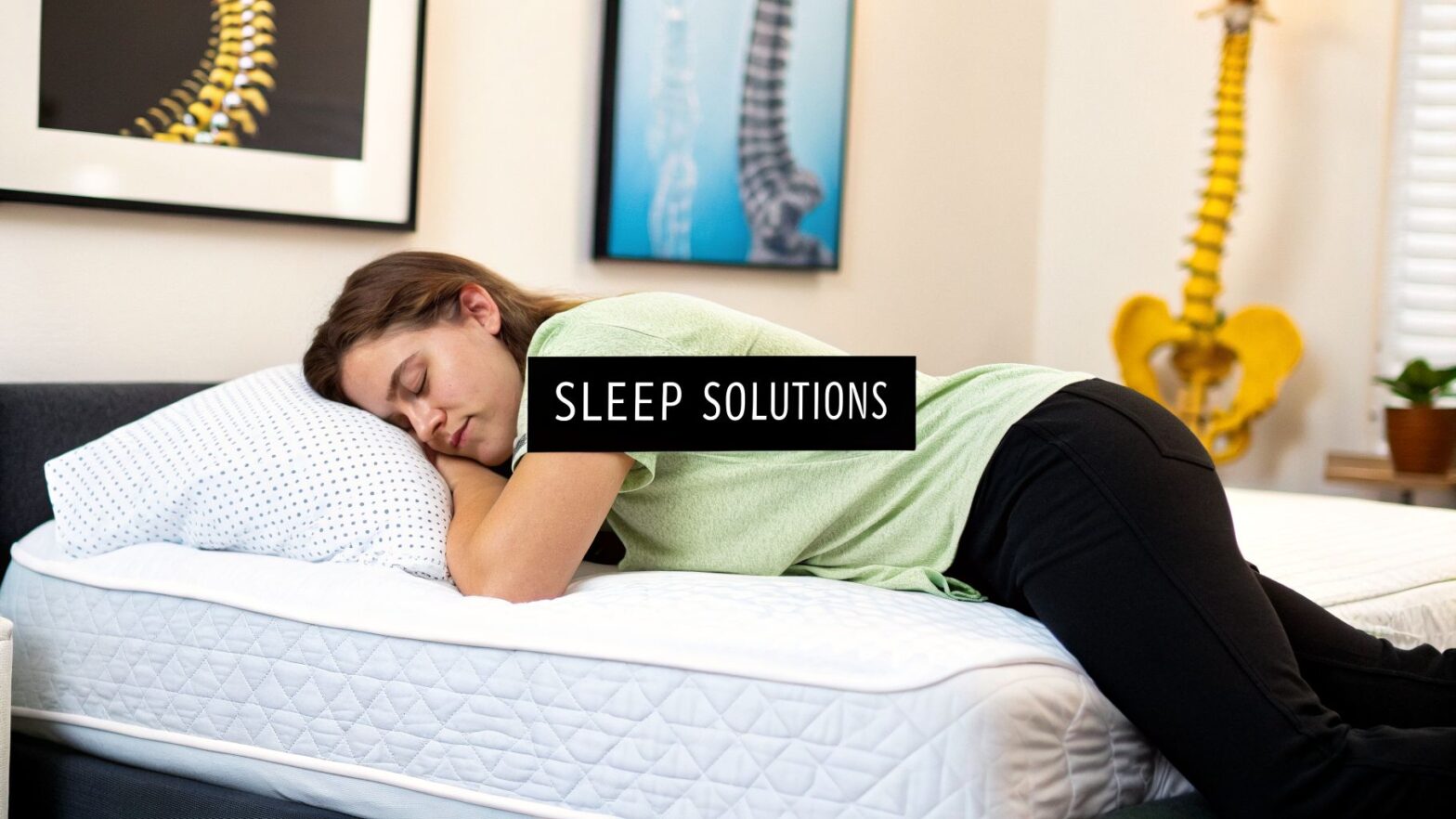
When a herniated disc sends shooting pain down your leg, getting a good night's sleep can feel like a distant dream. The two best sleeping positions for a herniated disc are on your side in a fetal position or on your back with your knees supported. Both of these help take the pressure off the nerve, giving you a real shot at relief and letting your body heal.
Finding Relief Tonight With The Right Sleeping Position
If you're in San Jose and dealing with a herniated disc, you know the nightly routine all too well: the tossing and turning, the sharp, jolting pain, and the frustration that turns your bed into a battleground instead of a sanctuary. At Resolve Chiropractic, we are your trusted local chiropractors, and we've seen firsthand how this struggle can spill over into your day, affecting your work, your family time, and your overall quality of life.
Lasting relief often starts with small but powerful changes. One of the most effective things you can do—starting tonight—is to adjust how you sleep. This guide is all about giving you practical, simple positions that can create a better healing environment for your spine.
The Foundation of Pain-Free Sleep
So, what's the goal here? Think of your spine as a series of stacked blocks (your vertebrae) with soft, jelly-filled cushions (your discs) in between. When a disc herniates, that jelly-like center pushes out, often pressing directly on a sensitive nerve. The key to sleeping better is to keep that stack of blocks as straight and stable as possible, which gives the pinched nerve a little more breathing room.
The right sleeping position does three crucial things:
- It keeps your spine in a neutral alignment, preventing any awkward twisting or bending that could make the nerve pressure worse.
- It takes the load off your spine by distributing your body weight more evenly.
- It can gently open up the spaces where nerves exit the spinal column, which is a big deal when a nerve is being crowded by a bulging disc.
This visual summary gives a great overview of what to do and what to avoid.

As you can see, sleeping on your side or back is your best bet for supporting spinal health. Sleeping on your stomach, on the other hand, puts your spine in a very compromised and stressful position.
Your Path to Relief with a San Jose Chiropractor
Changing your sleeping habits is a fantastic and necessary step for managing herniated disc pain. But it's often just one piece of the puzzle. While these positions can bring you significant relief, they don't fix the underlying structural problem that caused the disc to herniate in the first place. That’s where professional care from a back pain chiropractor in San Jose comes in.
At Resolve Chiropractic, our goal is to get to the root of the problem. We use specific Gonstead adjustments to restore proper alignment and get your nerve system functioning correctly, rather than just chasing the symptoms.
When you combine the right sleeping positions at night with the targeted chiropractic care we provide during the day, you create the ideal conditions for healing. You’re actively managing the pain while you rest, and we’re working on a long-term solution. If you’re tired of sleepless nights and the persistent pain from a herniated disc or sciatica, our team is here to help you find a real path forward.
How a Herniated Disc Can Derail Your Sleep and Daily Life

Before we can find a way to get you comfortable, we first need to understand what's really going on in your spine. Think of your spinal discs as miniature jelly donuts, perfectly positioned to provide a soft cushion between the hard, bony vertebrae. In a healthy spine, these discs are fantastic shock absorbers, letting you bend and move with ease.
The problem starts when a disc herniates. Its tough outer shell tears, and the soft, gel-like center begins to push its way out. That "leaked" gel is what causes all the trouble, as it can press directly on the incredibly sensitive nerves that branch out from your spinal cord.
This nerve pressure is what sets off the chain reaction of symptoms that many of our patients in San Jose, CA know all too well. It’s not just a simple backache; it's a persistent thief that robs you of your comfort, your mobility, and your peace of mind.
The Science Behind Your Symptoms
When that herniated disc material crowds a nerve, the signals traveling along that nerve get scrambled. This interference is what leads to a cascade of painful and frustrating symptoms that, for many, get significantly worse at night when the body is supposed to be healing.
Here’s what that nerve pressure can feel like:
- Radiating Pain: This is the hallmark symptom. When it involves the sciatic nerve, it's called sciatica—a sharp, shooting, or burning pain that can travel from your low back, through your buttock, and down your leg, sometimes reaching all the way to your foot.
- Numbness or Tingling: You might feel that "pins and needles" sensation or a weird lack of feeling in the part of your body serviced by that nerve. With a low back herniation, this is usually felt in the leg or foot.
- Muscle Weakness: Because nerves control muscles, compression can disrupt that signal. This can make it hard to lift your foot (a condition called foot drop) or even stand up on your toes.
These symptoms often flare up at night simply because lying down changes the pressures inside the spine. Depending on your position, you might actually be increasing the force on that irritated nerve root. For so many people, the end of the day signals the real beginning of their pain.
A herniated disc isn't just a diagnosis on a chart; it's a massive disruption to your life. It means missing out on weekend hikes at Alum Rock Park, struggling to focus through a workday, or not being able to lift your child without that jolt of pain.
Why Your Daily Life Suffers
The impact of a herniated disc goes far beyond the physical pain. That constant discomfort, combined with a lack of deep, restorative sleep, creates a domino effect that chips away at your daily function and your mental well-being. We see the frustration on our patients' faces every day here at our clinic.
Simple things that were once automatic—sitting at your desk, driving on the Guadalupe Parkway—can become agonizing. You start canceling plans with friends and family. The fear of triggering another flare-up often leads to a more sedentary and isolated life. This is precisely why finding a sciatica chiropractor in San Jose who sees the whole picture is so critical.
At Resolve Chiropractic, we don't just see a "herniated disc" on an imaging report. We see a person who desperately wants to get back to living their life without being held hostage by pain. Our process begins with advanced diagnostics to find the exact source of your nerve pressure. From there, we design a specific, gentle plan to correct the underlying problem, helping you not only sleep better but live better, too.
The Fetal Position: Creating Space for Your Nerves

When a herniated disc is causing you grief, sometimes the simplest change can bring the most relief. Curling up on your side—what many of us naturally do anyway—is one of the best ways to quiet an angry, compressed nerve. It’s more than just a comfortable pose; it’s a way to actively create space in your spine while you sleep.
Here’s what’s happening: when you lie on your side and gently bring your knees up toward your chest, you encourage a slight, healthy curve in your lower back. This movement subtly opens up the foramina, which are the small tunnels your nerve roots use to exit the spinal column. For anyone dealing with a herniated disc, even a tiny bit of extra room can be the difference between a night of shooting pain and one of peaceful rest.
Why This Position Works for Herniated Discs
Think of your spine as an accordion. Throughout the day, gravity and your body weight compress that accordion, squeezing the discs between each vertebra. Sleeping in a gentle fetal position is like pulling that accordion slightly open again. This simple act of decompression can take a significant amount of pressure off the bulging disc and the irritated nerve it’s pushing on.
This is a game-changer for conditions like lumbar herniated discs, where creating space is the primary goal. As chiropractors, we often guide our patients to adopt this position at night. It beautifully complements the specific Gonstead adjustments we perform in our San Jose clinic because it helps your body hold those corrections and heal more effectively while you're resting.
This isn't just a hunch; we see the results every day. For instance, sciatica—that sharp, radiating pain down the leg—affects about 40% of people with herniated discs, and this position can directly counter it. Tucking your knees up reduces the nerve-pinching that triggers the pain. Research also backs this up, showing that sleeping on your side with the right support leads to fewer spinal symptoms compared to sleeping on your stomach or in a twisted position. The experts at Florida Surgery Consultants also detail how this posture minimizes nerve compression.
How to Perfect the Fetal Position for Maximum Relief
Getting this right is about more than just curling into a ball. Without proper support, you could end up twisting your spine and making things worse. It’s all about the pillows.
Here’s the setup we walk our patients in San Jose, CA, through to ensure they get it right:
-
Pick a Side: Start by lying on your side. You can try lying on the side opposite your pain, but the most important thing is to listen to your body and choose whichever side feels more comfortable.
-
Support Your Head: Grab a pillow that's firm enough to fill the gap between your shoulder and head. The goal is to keep your neck perfectly straight, as a continuation of your spine. If your head is tilting down or propped up too high, you’re creating a new strain.
-
Bend Your Knees: Gently pull your knees toward your chest. You're not trying to fold yourself in half—a relaxed, gentle curve is all you need. Overdoing it can actually strain your back and neck.
-
Add a Pillow Between Your Knees: This is the non-negotiable step. Place a firm pillow between your knees (and ankles, if possible). This one simple trick stops your top leg from sliding forward, which prevents your pelvis and lower back from twisting out of alignment all night.
By using pillows to build a supportive nest, you’re giving your back muscles permission to fully relax. Instead of firing all night to keep your spine stable, they can finally rest, which allows for deeper, more restorative healing.
This setup ensures your spine stays in a neutral, happy line from top to bottom. It's a form of active rest that reinforces the work we do in the clinic.
The Gold Standard: How to Sleep on Your Back for Herniated Disc Relief

While curling up can feel great, many experts point to back sleeping as the ultimate position for spinal health. When you sleep on your back, you’re spreading your body weight over the largest possible area. This takes the pressure off any single point and lets your entire back, from your neck down to your hips, truly relax.
For someone dealing with a herniated disc, this is huge. It gives your spine a chance to rest in a neutral, natural alignment, which is absolutely essential for the healing process to begin.
But here’s the catch: just lying flat on your back often isn't enough. In fact, for some people, it can actually strain the lower back even more. The real magic happens when you use pillows to support your body's natural curves. Without that support, you risk letting your lower back arch too much, putting stress right where you don’t want it.
How to Create the Perfect Back-Sleeping Setup
Building this supportive nest is surprisingly simple—all you need are two pillows. Think of it as creating a custom cradle that holds your spine in the perfect position, allowing those angry discs and nerves to finally calm down overnight.
- Pillow #1 (Under the Knees): This is the game-changer. Slide a small or medium pillow under your knees. This slight elevation immediately softens the curve in your lower back, taking the pressure off your lumbar spine and reducing the load on the herniated disc.
- Pillow #2 (For Your Head): Grab a fairly thin but supportive pillow for your head. Your goal is to keep your neck aligned with the rest of your spine, not bent forward. If your pillow is too thick, it will push your chin toward your chest and create tension in your neck and upper back.
This two-pillow system creates an ideal environment for your spinal discs to decompress and rehydrate. This is especially crucial for our patients here in San Jose who often spend hours sitting—in traffic or at a desk—which puts constant compressive force on the lower back.
The Science Behind It
Sleeping on your back with your knees propped up isn't just about comfort; it's a therapeutic posture grounded in solid biomechanics. It’s one of the top recommendations for herniated disc relief precisely because it distributes your weight so evenly and maintains the spine's natural curves. This setup not only lessens the direct load on your lumbar discs but also eases muscle tension, which is why so many people notice less stiffness and nerve pain when they wake up.
Considering herniated discs affect over 5% of the U.S. population each year, finding simple, effective strategies like this is key.
At Resolve Chiropractic, we see this specific sleeping position as a cornerstone of at-home care. It essentially works as a passive therapy you can do for eight hours every single night, reinforcing the Gonstead adjustments we perform in the office to restore your spine's proper function.
This combination of professional care and smart at-home habits creates a powerful 24/7 healing cycle. While this sleeping position helps manage pain, it's also vital to strengthen the muscles that support your spine. For patients ready to take the next step, we've put together a guide on the best exercises for lower back pain to complement your recovery. As your trusted chiropractor in San Jose, CA, our goal is to give you both the hands-on treatment you need and the knowledge to protect your spine for the long haul.
Sleeping Positions That Make Herniated Disc Pain Worse
While finding the right sleeping position can feel like a breakthrough, it’s just as important to know which positions are working against you. Some postures don't just fail to provide relief—they can actually increase pressure on your herniated disc, making your pain and symptoms worse. To protect your spine, you need to be aware of these common pitfalls.
When it comes to a herniated disc, there's one position that's Public Enemy No. 1: sleeping on your stomach. It might feel comfortable at first, but it puts your neck and lower back into a mechanically stressful and unnatural alignment for hours at a time.
As your dedicated back pain chiropractor in San Jose, we spend a lot of time educating our patients about why avoiding this position is so critical for their recovery.
The Problem With Stomach Sleeping
When you lie on your stomach, you create a perfect storm for disc aggravation. First, it forces your lower back (the lumbar spine) into an excessive arch, flattening its natural curve. This can squeeze the back part of your discs, potentially pushing the herniated material further out and onto those already irritated nerves.
Second, you have to breathe. This forces you to twist your head completely to one side, holding it there all night. This prolonged rotation puts a tremendous amount of strain on the vertebrae and discs in your neck. It’s like holding a constant, awkward stretch while you sleep, which can easily lead to stiffness, neck pain, or even new disc problems down the road.
Think of your spine as a finely tuned instrument. Stomach sleeping is like twisting its strings out of tune every single night, making it impossible to produce a harmonious, pain-free day.
The Pitfalls of Unsupported Side Sleeping
Although side sleeping is generally a great choice, it can go wrong without the right support. A lot of people sleep on their side but neglect their pillow setup, causing a spinal misalignment that can easily aggravate a herniated disc.
The most common mistake we see is letting the top leg slide forward and drop down onto the mattress. This simple movement drags your pelvis with it, creating a subtle but constant twisting motion in your lower back. That rotational stress is exactly what you need to avoid when you're dealing with a disc injury or sciatica.
Here’s how to fix it and keep your spine in a neutral line:
- A pillow between your knees is a non-negotiable. This simple addition is the key to keeping your hips, pelvis, and spine properly aligned.
- A supportive head pillow is just as crucial. It must be the right height to fill the space between your ear and the mattress, keeping your neck straight.
By pointing out these common errors, we hope to empower our community in San Jose, CA, to make smarter choices that protect their spines at home. This kind of practical education is a core part of what we do at Resolve Chiropractic. It goes hand-in-hand with the specific Gonstead adjustments we provide in the clinic, creating a complete strategy for lasting relief and true spinal correction.
How Our San Jose Chiropractors Treat Herniated Discs
Finding the right sleeping position is a fantastic first step for managing the pain from a herniated disc. But it's important to see it for what it is: symptom relief. Think of it like putting a bucket under a leaky pipe—it keeps the floor dry, but it doesn't actually fix the leak. For real, lasting relief that lets you get back to your life, you have to address what's causing the disc injury in the first place.
That’s where our work at Resolve Chiropractic comes in. We’re not here to just chase the pain. As chiropractors in San Jose, we’re focused on figuring out why the disc herniated. We look for the underlying spinal misalignments that put that pressure on the disc and then work to correct them. The goal is simple: restore your body's own ability to heal so you can live without being held back by pain.
A Specific, Scientific Approach to Healing
We practice a very specific and thorough method of chiropractic care called the Gonstead technique. This is so much more than just "cracking" your back. It starts with a comprehensive five-step analysis to find the exact source of nerve pressure. This allows us to create a treatment plan that's truly unique to your spine and your injury.
Here’s what you can expect when you visit our San Jose chiropractic clinic:
- X-Ray Imaging: We take weight-bearing X-rays, which show us how your spine is handling gravity. This lets us see the true alignment, measure disc height, and pinpoint structural problems that other imaging might miss.
- Instrumentation: We use a special handheld instrument that glides down your back. It detects tiny temperature variations along the spine, which are often clear indicators of inflammation and nerve pressure.
- Static and Motion Palpation: Our doctors use their hands to feel your spine, both while you’re still and as you move. We're looking for swelling, tenderness, and joints that aren't moving the way they should.
- Visualization: A huge part of our diagnosis comes from simply watching. We observe your posture and the way you walk, looking for subtle imbalances that give us clues about what's happening with your spine.
This deep dive allows us to deliver precise, gentle adjustments targeted at the specific vertebrae causing your herniated disc issues.
By correcting these specific misalignments, we can finally take the pressure off the irritated nerves and damaged discs. This does more than just relieve pain—it restores proper communication between your brain and body, unlocking its incredible power to heal from the inside out.
More Than Just Adjustments
An adjustment is the core of what we do, but a full recovery often needs more support. Depending on what we find, we might bring in other therapies to help speed up the healing process. For example, spinal decompression is a game-changer for many people with herniated discs. It gently stretches the spine, creating a small vacuum effect that helps pull the bulging disc material back into place.
Because disc problems can happen at any time of life, we also provide specialized care for different needs. Our prenatal chiropractic care offers a safe and effective way for expecting mothers to find relief, using special tables and pillows to ensure total comfort and safety. We know a herniated disc isn't just a back problem—it affects your whole life. Our goal is to provide the non-surgical solutions you need to get back on your feet. For those dealing with pain that shoots down the leg, we also offer our approach to non-surgical treatment for sciatica.
Ultimately, a great recovery comes from a 24/7 approach. When you combine the right sleeping positions for a herniated disc with our specific Gonstead chiropractic care, you create an environment for healing around the clock. You manage the symptoms while you rest, and we work on fixing the root cause. This is how we help our patients in San Jose find lasting relief and get back to doing what they love.
Your Questions About Sleeping With a Herniated Disc Answered
When you're dealing with a herniated disc, a lot of questions pop up, especially when you're just trying to get a decent night's sleep. We hear these questions all the time at our San Jose chiropractic clinic. Let's walk through the most common ones so you can rest a little easier.
What Is the Single Best Pillow for a Herniated Disc?
This is a great question, but there's really no single "best" pillow that works for everyone. The right pillow is all about one thing: spinal alignment. Your pillow’s only job is to keep your head and neck in a straight line with the rest of your spine.
- Back sleepers usually do best with a thinner, contoured pillow. You want something that supports the natural curve of your neck without propping your head up too high.
- Side sleepers need something thicker and firmer. The goal is to perfectly fill the gap between your ear and the outside of your shoulder to keep your head from dropping down.
At Resolve Chiropractic in San Jose, we can give you a personalized recommendation based on your unique posture and spinal needs.
Should I Use a Firm or Soft Mattress?
For most people with a herniated disc, a medium-firm mattress is the sweet spot. Think of it as the best of both worlds—it's supportive enough to keep your spine from sagging into a banana shape, but soft enough to cushion your hips and shoulders and avoid creating new pain points.
A mattress that’s too soft is like sleeping in a hammock; it lets your spine collapse out of alignment. On the flip side, one that's rock-hard can put way too much pressure on your joints.
How Soon Will I Feel Better After Changing My Sleeping Position?
It's not uncommon to feel a difference in morning pain and stiffness within just a few nights of sleeping in a better position. But it's important to have realistic expectations. Changing your sleeping posture is a powerful tool for managing symptoms, but it won't fix the disc itself.
True, lasting relief happens when you address the root cause of the problem. Our patients in San Jose consistently find that the biggest breakthroughs come from combining better sleeping habits with the specific Gonstead chiropractic adjustments we perform in the clinic.
Can I Ever Sleep on My Stomach Again?
We strongly advise all our patients to avoid stomach sleeping. It puts a tremendous amount of strain on your neck and lower back. Not only does it flatten your spine's healthy curves, but it also forces your head to be twisted to one side for hours. It’s a recipe for disaster when you're trying to heal.
Our goal is always to help you heal completely so you can live without limitations. Once we've used Gonstead chiropractic care to stabilize your spine, we can re-evaluate. But honestly, learning to sleep on your back or side is the single best long-term strategy for protecting your spine for years to come.
Are you ready to stop just managing the pain and start actually fixing the problem? If you're looking for a chiropractor near me in the San Jose area, the team at Resolve Chiropractic is dedicated to helping you get back to a life without pain. Book your appointment online and let's create a specific plan for your recovery.