




Neck pain is a pervasive issue for many in San Jose, CA, often stemming from long hours at a desk, commuting stress, or even an old auto injury. The persistent ache, stiffness, and limited mobility can disrupt work, sleep, and daily life, making it difficult to function at your best. While you may be searching online for a “chiropractor near me,” finding lasting relief comes from addressing the root cause, which often involves muscular imbalances, postural strain, and underlying spinal misalignments.
At Resolve Chiropractic, our dedicated team understands the unique biomechanics of the cervical spine. As a trusted local provider for neck pain in San Jose, we’ve created this chiropractor-approved guide to the best exercises for neck pain. These movements are designed to complement the specific, evidence-driven care we offer our patients. They are more than just simple stretches; they are foundational steps to rebuild strength, restore proper posture, and empower your body’s natural healing process.
Inside, you will find step-by-step instructions for each exercise, including recommended sets, repetitions, and important safety considerations. This information is structured to help you regain control and build resilience against future pain. Before you begin, remember that exercise should never cause sharp or radiating pain. If you’re experiencing severe symptoms or have a diagnosed condition like a disc injury or sciatica, it’s crucial to seek professional guidance. As your trusted chiropractor in San Jose, we are here to provide an accurate diagnosis and create a personalized care plan that integrates these exercises safely and effectively for long-term relief.
1. Neck Stretches (Cervical Range of Motion Exercises)
At the foundation of any effective neck pain relief program are gentle, controlled stretches that guide the neck through its natural range of motion. Known as cervical range of motion (ROM) exercises, these movements are designed to reduce muscle tension, improve flexibility, and restore mobility in the cervical spine. They are often the first step in alleviating the stiffness and nerve compression that contribute to persistent neck pain, making them one of the best exercises for neck pain.
These foundational exercises systematically move the neck in all directions: forward (flexion), backward (extension), side-to-side (lateral flexion), and turning (rotation). By gently encouraging these movements, you can counteract the postural strain from daily activities, such as working at a desk in San Jose or looking down at a phone.

How to Perform Cervical Range of Motion Exercises
To get the most out of these stretches, focus on slow, deliberate movements. Never force a stretch or move into a position that causes sharp pain.
- Chin Tucks (Flexion): Sit or stand tall. Gently tuck your chin toward your chest until you feel a light stretch along the back of your neck. Hold for 15-30 seconds.
- Neck Extension: Slowly tilt your head backward, looking up toward the ceiling. Hold the stretch for 15-30 seconds.
- Lateral Flexion: Keeping your shoulders relaxed, slowly tilt your right ear toward your right shoulder. Hold for 15-30 seconds, then repeat on the left side.
- Neck Rotation: Turn your head slowly to the right, as if looking over your shoulder. Hold for 15-30 seconds, then repeat on the left side.
Chiropractor’s Insight: The key to these stretches is consistency. Aim to perform them 2-3 times daily, especially if you have a sedentary job. For our patients in San Jose, we often recommend setting a timer to take a stretch break every hour to prevent muscle tightening.
For optimal results, combining these exercises with professional chiropractic care can address the underlying spinal misalignments causing your discomfort. At Resolve Chiropractic, we integrate targeted exercises into our treatment plans to help you achieve lasting relief from neck pain.
2. Neck Isometric Exercises
Once you have established a comfortable range of motion, the next step is to build strength and stability. Neck isometric exercises are a safe and highly effective way to strengthen the cervical muscles without requiring movement, making them an excellent choice for individuals recovering from an injury or experiencing acute pain. This static strengthening method involves contracting the neck muscles against a fixed resistance, such as your hand, which helps stabilize the cervical spine and prevent future strain.
These exercises are particularly valuable for building endurance in the deep neck flexors, the muscles responsible for maintaining proper head and neck posture. By strengthening these foundational muscles, you can improve alignment and reduce the chronic stress placed on your neck from activities like working at a computer in San Jose or recovering from a whiplash injury. Because they don’t involve joint movement, neck isometrics are one of the best exercises for neck pain during the early stages of recovery.
How to Perform Neck Isometric Exercises
The goal is to create muscle tension without moving your head. Apply gentle, steady pressure and remember to breathe throughout each contraction.
- Isometric Flexion (Forward): Place your palm on your forehead. Gently press your head forward into your hand while your hand provides resistance to prevent movement. Hold for 10-15 seconds.
- Isometric Extension (Backward): Clasp your hands behind your head. Gently press your head backward into your hands, using them to resist the motion. Hold for 10-15 seconds.
- Isometric Lateral Flexion (Side): Place your right palm on the right side of your head. Press your head into your palm as if trying to touch your ear to your shoulder, while your hand resists. Hold for 10-15 seconds and repeat on the left side.
- Isometric Rotation (Turning): Place your right hand on the side of your head above your ear. Attempt to turn your head to the right while your hand prevents the rotation. Hold for 10-15 seconds and repeat on the left side.
Chiropractor’s Insight: Resistance should be moderate, about 25-50% of your maximum effort. The purpose is to activate the muscles, not strain them. As auto injury chiropractors, we often incorporate these exercises into treatment plans for our San Jose patients to rebuild stability safely.
At Resolve Chiropractic, we guide patients through proper exercise techniques to complement their spinal adjustments. Integrating isometrics helps reinforce proper alignment and builds the strength needed for lasting neck pain relief.
3. Chin Tucks (Cervical Retraction)
Among the most powerful yet simple movements for neck pain relief is the chin tuck, also known as cervical retraction. This exercise specifically targets the deep cervical flexor muscles at the front of your neck, which are often weak and underused. Its primary goal is to counteract forward head posture, a major contributor to chronic neck pain, stiffness, and headaches, especially for those with desk jobs in San Jose.
The exercise involves gently pulling your head and chin straight back, creating a “double chin” effect without tilting your head. This movement helps realign the vertebrae in your neck, alleviating pressure on nerves and discs. By retraining the muscles responsible for proper posture, chin tucks are one of the best exercises for neck pain stemming from modern habits like prolonged screen time.
How to Perform Chin Tucks
Correct form is crucial for activating the right muscles and preventing strain. Start slowly and focus on the quality of the movement.
- Starting Position: Sit or stand tall with your spine straight, shoulders relaxed, and head in a neutral position. Look straight ahead.
- The Movement: Without tilting your head up or down, gently draw your chin and head straight backward. Imagine you are trying to make a double chin.
- Hold and Release: You should feel a gentle stretch at the base of your skull and an engagement of the muscles in the front of your neck. Hold this position for 5-10 seconds, then slowly release back to the neutral starting position.
- Repetitions: Aim for 10-15 repetitions per set.
Chiropractor’s Insight: To ensure you’re doing it correctly, try performing chin tucks while standing with your back against a wall. Your head should gently move back to touch the wall. We often recommend this exercise to our patients in San Jose, especially software developers and students, to perform several times throughout the day to break the cycle of postural strain.
At Resolve Chiropractic, we frequently prescribe chin tucks to complement our chiropractic adjustments. This exercise helps stabilize the cervical spine and maintain the alignment achieved during treatment, providing you with more effective and lasting relief from neck pain.
4. Shoulder Rolls and Scapular Stabilization
The health of your neck is deeply connected to the stability and function of your shoulders and upper back. Shoulder rolls and scapular stabilization exercises target the crucial muscles that support your cervical spine, such as the rhomboids and trapezius. When these muscles are weak or inactive, often due to prolonged sitting, the neck muscles are forced to overcompensate, leading to strain, stiffness, and chronic pain.
These movements are designed to improve the mind-muscle connection with your shoulder blades (scapulae) and strengthen the supporting musculature. By activating these key stabilizers, you can correct poor posture, reduce the load on your neck, and create a stronger foundation for a healthy upper body. For anyone suffering from persistent neck pain, addressing scapular function is a critical and often overlooked step, making these some of the best exercises for neck pain.
How to Perform Shoulder and Scapular Exercises
The focus here is on control and precision. Avoid using momentum and concentrate on feeling the target muscles engage around your shoulder blades.
- Shoulder Rolls: Sit or stand with a tall, neutral spine. Inhale as you slowly lift your shoulders up toward your ears, then exhale as you roll them back and down, gently squeezing your shoulder blades together. Perform 10-15 repetitions backward, then reverse the motion for 10-15 repetitions forward.
- Scapular Squeezes: While seated or standing, keep your arms relaxed at your sides. Gently pull your shoulder blades together and down, as if you are trying to pinch a pencil between them. Hold this contraction for 5-10 seconds without shrugging your shoulders up. Release and repeat 10-15 times.
- Wall Angels: Stand with your back against a wall, with your feet about six inches away. Place your arms against the wall in a “goalpost” position. Slowly slide your arms up the wall as high as you can while keeping your elbows and wrists in contact. Return to the starting position. Perform 8-12 repetitions.
Chiropractor’s Insight: Many of our San Jose patients with desk jobs present with weak lower trapezius and overactive upper trapezius muscles. Scapular stabilization exercises directly counteract this common imbalance. Focus on the “down and back” motion to properly engage the correct muscles and take the strain off your neck.
At Resolve Chiropractic, we evaluate the entire kinetic chain, from your neck to your shoulders and mid-back. Integrating these stabilization exercises into your chiropractic care plan helps ensure that the spinal adjustments we perform hold longer, providing you with more sustainable relief from neck pain.
5. Upper Back Extension (Prone Cobra or Controlled Extensions)
To effectively address neck pain, it is crucial to look beyond the neck itself and focus on the supporting structures of the upper back (thoracic spine). Upper back extension exercises strengthen the posterior chain muscles that counteract the forward-flexed, “tech neck” posture dominating modern life. By building endurance in these muscles, you create a stronger foundation that reduces the chronic strain placed on the cervical spine, making this one of the best exercises for neck pain.
Movements like the prone cobra or other controlled extensions are designed to lengthen tight chest muscles while simultaneously activating the weaker muscles in your upper back, such as the rhomboids and lower trapezius. This rebalancing act addresses the mechanical cause of postural neck pain, helping to restore a more neutral and stable alignment. For office workers in San Jose rebuilding postural endurance, these exercises are an essential component of long-term relief.
How to Perform the Prone Cobra
Focus on control and muscle engagement rather than lifting as high as you can. The goal is to feel the muscles between your shoulder blades doing the work.
- Starting Position: Lie face down on a mat with your arms by your sides, palms facing down. Your forehead should be resting on the floor.
- Engagement: Gently squeeze your shoulder blades together and down, away from your ears.
- Lift: Keeping your chin slightly tucked and your neck long, lift your head, chest, and arms off the floor. Keep your gaze directed at the floor to avoid straining your neck.
- Hold and Lower: Hold the position for 3-5 seconds, then slowly lower yourself back to the starting position with control. Aim for 10-15 repetitions.
Chiropractor’s Insight: The most common mistake with this exercise is using the lower back to lift or arching the neck backward. Focus entirely on the upper back muscles. For our patients recovering from whiplash or auto injuries, we emphasize starting with a very small range of motion to rebuild stability safely.
At Resolve Chiropractic, we frequently incorporate corrective exercises like the prone cobra into our treatment plans. By combining these targeted movements with chiropractic adjustments, we help San Jose residents correct the postural imbalances that are often the root cause of persistent neck pain.
6. Cervical Stabilization with Resistance Bands
For those ready to move beyond foundational stretches and into active strengthening, cervical stabilization exercises with resistance bands are a crucial next step. These exercises provide controlled, progressive resistance to build strength in the deep muscles supporting the neck. By using bands, you can customize the intensity, allowing for safe strength building that challenges your muscles without overloading the delicate structures of the cervical spine, making this one of the best exercises for neck pain.
This method is highly effective for addressing the muscular imbalances that often lead to chronic neck issues. By building dynamic stability throughout the cervical spine, you create a stronger, more resilient support system for your head, which helps prevent future pain episodes. These exercises are invaluable for patients in San Jose looking to maintain strength gains from chiropractic care or for athletes integrating cervical stability into their performance training.
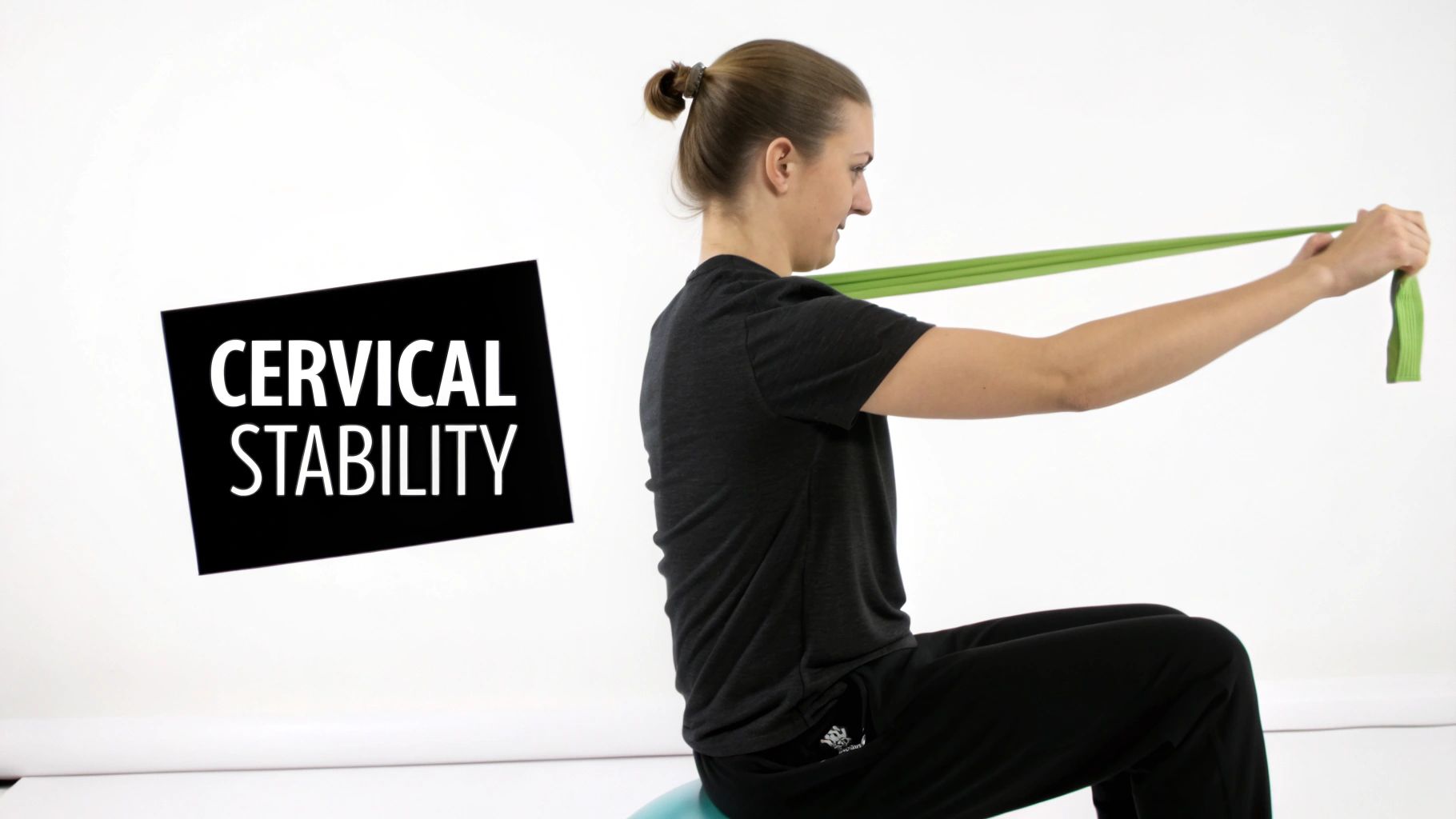
How to Perform Cervical Stabilization with Resistance Bands
Proper form is essential to safely strengthen the neck muscles. Begin with a light resistance band and focus on maintaining a neutral spine position throughout each movement.
- Isometric Flexion: Secure the band to a stable anchor point behind you. Place the band around your forehead. Gently resist the pull of the band by engaging your neck muscles, keeping your head from being pulled backward. Hold for 10-15 seconds.
- Isometric Extension: Face the anchor point and place the band around the back of your head. Resist the forward pull, engaging the muscles at the back of your neck. Hold for 10-15 seconds.
- Isometric Lateral Flexion: Stand with the anchor point to your right. Place the band around the right side of your head. Resist the pull to the right, keeping your head centered over your shoulders. Hold for 10-15 seconds, then repeat on the left side.
Chiropractor’s Insight: The goal here is stabilization, not large movements. You should feel the muscles working without significant head motion. Start with 1 set of 12-15 repetitions (or holds) and aim to perform these exercises 3-4 times weekly as your strength improves.
For lasting relief, combining a targeted strengthening program with professional chiropractic care is key. At Resolve Chiropractic, we design personalized exercise plans to complement your adjustments, ensuring you not only find relief from neck pain but also build the strength to keep it from returning.
7. Postural Re-education and Ergonomic Correction
While specific exercises are crucial, they are most effective when paired with correcting the daily habits that cause neck pain in the first place. Postural re-education focuses on developing a conscious awareness of your body’s alignment during all activities. This approach addresses the root cause of chronic neck strain by retraining your nervous system to maintain a healthy posture, whether you’re working, driving, or relaxing.
By making simple but consistent ergonomic adjustments, you can significantly reduce the cumulative stress on your cervical spine. For many professionals in San Jose, from tech workers to commuters, poor ergonomics are a primary contributor to persistent neck issues. Correcting these environmental and habitual factors is a fundamental step in achieving long-term relief and is one of the best exercises for neck pain because it works all day long.
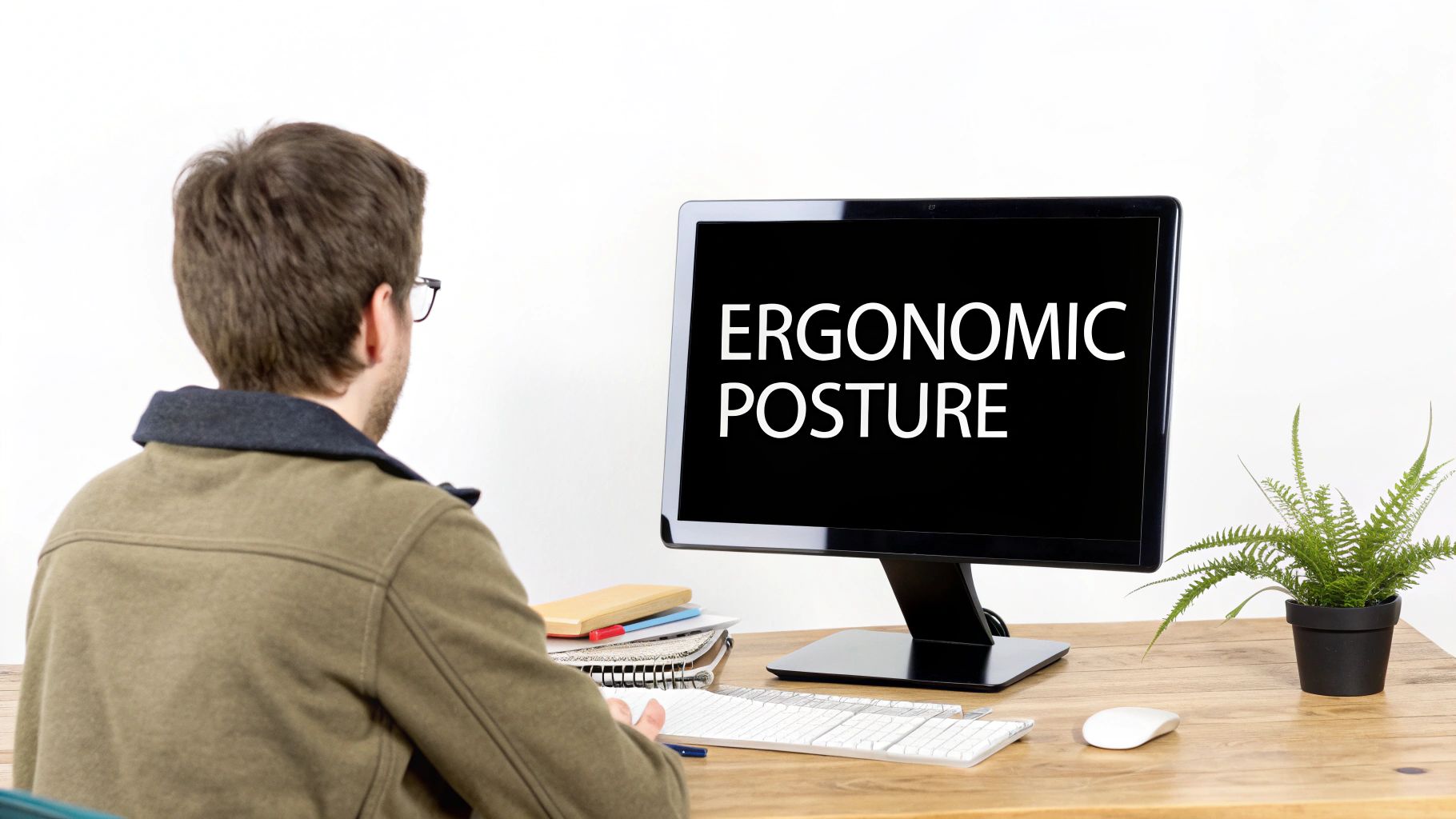
How to Implement Postural and Ergonomic Changes
Integrating these changes into your daily routine requires mindfulness and consistency. Start by focusing on one or two adjustments and build from there.
- Optimize Your Workstation: Position your computer monitor at eye level and about an arm’s length away. Your elbows should be bent at a comfortable 90-degree angle with your shoulders relaxed.
- Mind Your Phone Habits: Avoid “text neck” by holding your phone closer to eye level. When making calls, use a headset or speakerphone instead of cradling the phone between your ear and shoulder.
- Set Movement Reminders: Take short breaks every 30-60 minutes to stand up, stretch, and reset your posture. This prevents muscles from locking into a strained position.
- Improve Sleep Posture: Use a supportive pillow that keeps your neck in a neutral position, aligned with the rest of your spine. Avoid sleeping on your stomach, which forces your head to twist for hours.
- Conduct Daily Posture Checks: Periodically check your alignment. Are your shoulders rolled forward? Is your head jutting out? Gently pull your shoulder blades back and down and tuck your chin slightly.
Chiropractor’s Insight: Think of good posture as a continuous, gentle exercise. The goal is to make a neutral spine your default position. We guide our patients in San Jose on how to make practical ergonomic adjustments at home and in the office, which is a game-changer for preventing the recurrence of neck pain.
Lasting relief often requires a comprehensive approach. Combining these postural corrections with professional chiropractic care can address underlying spinal misalignments that your habits have created. To learn more about how our targeted treatments can help, explore our services for neck pain relief.
8. Gentle Cervical Traction and Decompression Movements
For neck pain stemming from compressed nerves or bulging discs, gentle cervical traction and decompression movements offer a powerful form of relief. These exercises work by creating a light, sustained stretch in the neck, which gently separates the vertebrae. This separation can increase the space around nerve roots and intervertebral discs, alleviating pressure and reducing pain that radiates down the arm, a condition known as cervical radiculopathy.
This method is particularly valuable as it directly addresses the mechanical compression that causes significant discomfort. By decompressing the spine, these movements can improve circulation, reduce inflammation, and enhance healing within the disc material. For individuals in San Jose dealing with disc-related issues or nerve impingement, incorporating these exercises can be a game-changer for restoring function and finding lasting comfort, making them one of the best exercises for neck pain.
How to Perform Gentle Cervical Traction Exercises
These movements must be performed with extreme care and control. Never use sudden or forceful motions, and always stop if you experience an increase in pain.
- Towel-Assisted Neck Traction: Lie on your back and place a rolled-up towel under your neck. Hold both ends of the towel and gently pull it forward and slightly upward, creating a light stretch. Hold for 10-15 seconds before slowly releasing.
- Manual Chin-Cradle Traction: While lying on your back, interlace your fingers and place your hands under the base of your skull. Gently pull your head away from your shoulders, aiming toward the head of the bed or floor. Hold the gentle traction for 20-30 seconds.
- Wall-Assisted Head Lift: Lie on the floor with your head near a wall and your knees bent. Gently press the back of your head into the floor while simultaneously trying to lengthen your neck, as if a string is pulling the top of your head toward the wall. Hold for 5-10 seconds.
Chiropractor’s Insight: Traction is not suitable for everyone, especially those with spinal instability or certain other conditions. It’s crucial to start with very gentle forces and short durations. For our patients in San Jose, we often supervise the initial sessions to ensure proper form and determine the appropriate intensity.
Professional, in-office treatments like spinal decompression therapy use precise, computer-controlled forces to achieve optimal results safely. At Resolve Chiropractic, we use this advanced technology to provide targeted relief for disc herniations and nerve compression, integrating it with a personalized exercise plan to support your recovery.
Top 8 Neck Pain Exercises — Comparison
| Intervention | Implementation complexity | Resource requirements | Expected outcomes | Ideal use cases | Key advantages |
|---|---|---|---|---|---|
| Neck Stretches (Cervical ROM) | Low — simple multi-plane movements | None; seated or standing space | Immediate tension relief; improved flexibility; temporary without consistency | Office breaks, mild stiffness, general maintenance | Accessible, low risk, easy to perform anywhere |
| Neck Isometric Exercises | Low–Medium — technique dependent | None (manual resistance) | Gradual increase in strength and stability; safe for healing tissues | Acute/chronic pain rehab, post-injury stabilization | Builds strength without joint motion; safe for sensitive tissues |
| Chin Tucks (Cervical Retraction) | Low — simple but form-sensitive | None; optional resistance band for progressions | Improved deep neck flexor control; correction of forward head posture over time | Desk workers, posture correction, post-chiro maintenance | Directly targets postural root cause; discreet and low risk |
| Shoulder Rolls & Scapular Stabilization | Medium — requires scapular control knowledge | Bodyweight, bands or light weights recommended | Improved scapular mechanics; reduced referred neck pain; better posture | Athletes, overhead workers, people with postural imbalance | Enhances upper-body support for the neck; prevents shoulder-related referral |
| Upper Back Extension (Prone Cobra) | Medium — needs core engagement and progression | Mat, bodyweight; optional bands/weights | Increased thoracic extension and postural endurance; reduced cervical load | Postural rehab, chronic forward-head, post-whiplash | Reverses rounded posture; builds endurance supporting cervical spine |
| Cervical Stabilization with Resistance Bands | Medium — requires setup and progression plan | Resistance bands and stable anchor point | Progressive multi-planar strength and dynamic stability | Post-rehab strengthening, athletes, long-term maintenance | Adjustable resistance; portable and safer than heavy weights |
| Gentle Cervical Traction & Decompression | Medium–High — technique- and equipment-dependent | Traction device or supervised manual technique; appropriate setup | Reduced nerve root compression and radicular symptoms; often immediate but sometimes temporary | Radiculopathy, disc herniation, nerve-compression cases | Non-invasive decompression; effective for nerve-related symptom relief |
What to Expect When Visiting Our San Jose Chiropractic Clinic
Navigating neck pain can be a frustrating journey, but you’ve now equipped yourself with a powerful toolkit. This guide has detailed eight of the best exercises for neck pain, from foundational stretches to more advanced stabilization techniques. Integrating these into your routine is a proactive step toward taking back control from chronic discomfort. However, while exercises address symptoms, they may not correct the underlying structural issues.
This is where professional, targeted chiropractic care becomes essential. At Resolve Chiropractic, your first visit is a comprehensive process designed to uncover the root cause of your pain. We listen to your concerns, review your health history, and conduct a detailed examination. Using specific analysis, including X-rays and instrumentation, we pinpoint the exact source of your problem. This allows us to create a care plan that is unique to your spine and your condition—whether it’s from an auto injury, postural strain, or a degenerative issue.
Our precise, scientific adjustments are designed to restore proper spinal alignment and nerve function, allowing your body to heal naturally. We then integrate specific exercises from this guide to support and maintain your progress, creating a synergistic effect for faster, more sustainable results.
Why Professional Guidance Is Your Most Important Next Step
While these exercises are highly effective, they are one piece of a larger puzzle. They can address muscular imbalances, but they may not correct the specific spinal misalignment, or subluxation, that requires a precise correction to restore proper nerve function and allow the body to heal. Our Gonstead-based approach doesn’t guess; we test.
Many patients from San Jose and the surrounding areas come to us after trying exercises on their own without lasting success. By combining our precise adjustments with a personalized plan of the best exercises for neck pain, we create a comprehensive strategy that addresses both the cause and the symptoms.
Ready to address the root cause of your neck pain and enhance the benefits of your exercise routine? The expert team at Resolve Chiropractic in San Jose, CA, is here to provide a precise diagnosis and personalized treatment plan to restore your body’s natural function and help you achieve a pain-free life.
Schedule Your Consultation Today
Take the next step toward lasting relief. Visit us online at Resolve Chiropractic to schedule your initial consultation and discover the difference that specific, scientific chiropractic care can make for your neck pain.