



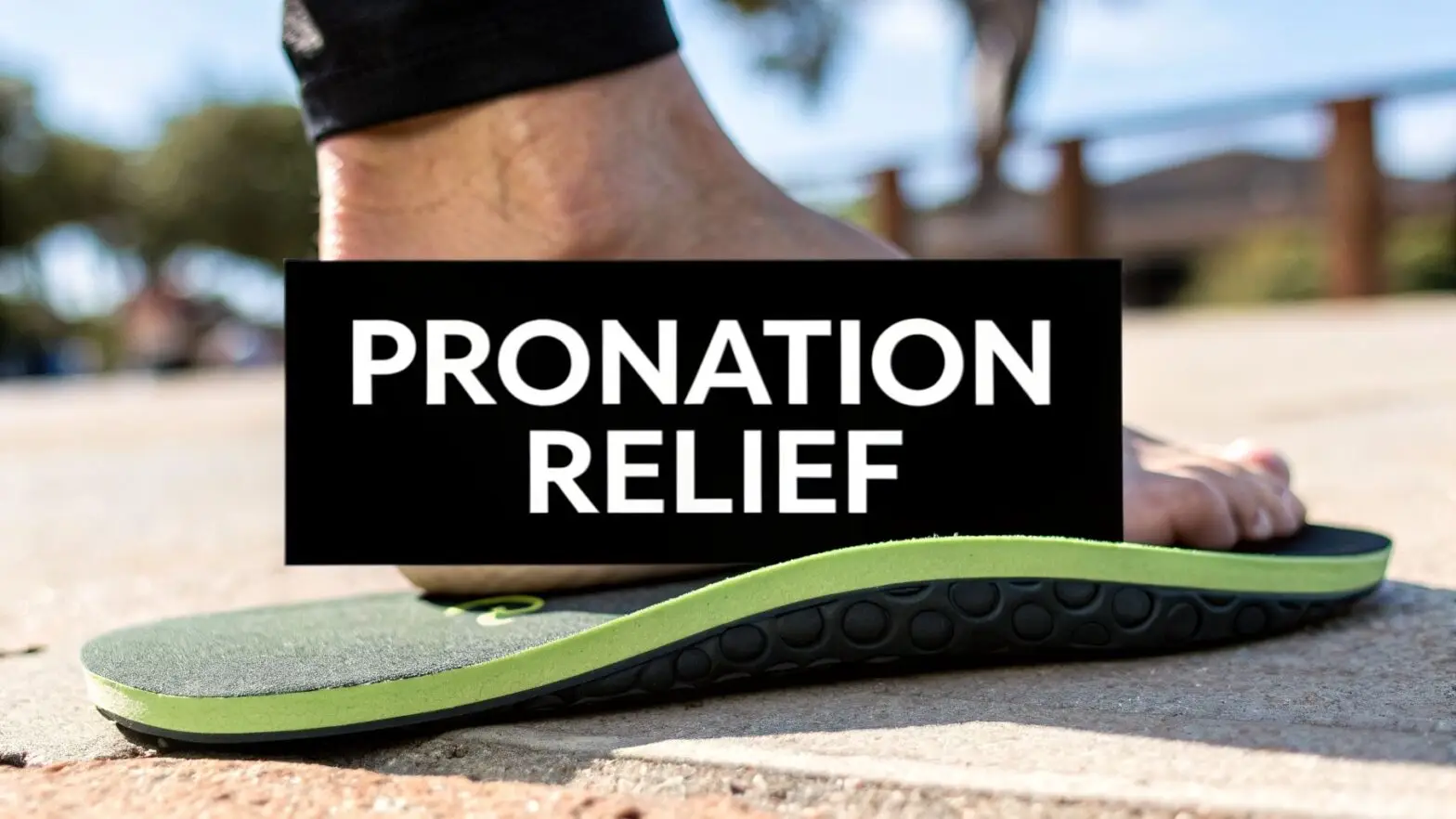
If you’re struggling with foot, knee, hip, or even back pain in San Jose, the solution might be simpler than you think. As local chiropractors, we often trace these issues back to an unstable foundation—your feet. Orthotic shoe inserts, especially those custom-molded for your unique needs, are designed to correct how your foot moves, providing the right support to stop it from rolling too far inward and throwing your whole body out of alignment.
How Your Feet Can Affect Your Entire Body

When patients come to our San Jose clinic with persistent pain, they’re often surprised when we start by looking at their feet. But it makes perfect sense. Your feet are your foundation, and if that foundation is unstable, the problem rarely stays in one place. The culprit is often a common biomechanical issue called pronation.
Pronation isn't a bad thing on its own. It’s simply the natural, side-to-side motion of your foot when you walk or run. As your heel hits the ground, your foot should roll inward just a bit to absorb the shock and adapt to the surface. That’s your body’s built-in suspension system doing its job.
When Pronation Goes Too Far
The real trouble starts with overpronation—when your foot rolls inward too much.
Think of it like the alignment on your car. If the tires are crooked, you don't just get uneven wear. It stresses the axle, messes with the suspension, and can even strain the car's frame over time. Your body works the same way. When your feet overpronate, they create a ripple effect of instability that travels right up your body.
This chain reaction puts undue stress on your entire kinetic chain, leading to problems like:
- Ankles and Knees: The excessive inward roll forces your shin bone (tibia) to rotate, putting a twisting force on your knee joint that it wasn't designed to handle. This is a common cause of knee pain for our San Jose patients.
- Hips and Pelvis: This misalignment continues upward, often causing the pelvis to tilt forward. This can lead to nagging hip pain and a feeling of instability.
- Lower Back and Spine: An unstable pelvis forces your spine to compensate, which is a recipe for chronic low back pain, muscle fatigue, and even sciatica—a condition we treat frequently with chiropractic care.
From Foot Problems to Headaches
It sounds like a stretch, but here at our San Jose chiropractic clinic, we regularly trace a patient's nagging headaches or low back pain all the way back to their feet. When your body is constantly fighting an unstable foundation, the muscles all the way up to your neck and shoulders tense up to compensate.
This issue is incredibly common. Overpronation affects millions, and it’s a known contributor to everything from neck pain to tension headaches. The growing awareness is clear—in 2022, the North American orthotic insole market was valued at $1.38 billion. Globally, that number is expected to jump from $3.58 billion in 2023 to $5.78 billion by 2030 as more people realize that fixing their feet can resolve problems elsewhere.
The pain you feel in your back or neck may not be where the problem starts. By addressing instability in your feet, we can often resolve issues that seem completely unrelated.
Fixing this foundational imbalance is key to finding lasting relief. At Resolve Chiropractic, we focus on getting to the root of your pain. For many of our patients in San Jose, that journey starts from the ground up.
You can learn more about how we diagnose and treat foot-related pain in our San Jose clinic.
How Orthotic Inserts Guide Your Feet Back Into Line
When you're dealing with overpronation, the right orthotic shoe inserts for pronation can be a game-changer. It’s a common mistake to think of them as just another cushioned insole, but they're far more sophisticated. Think of them less as a pillow and more as a guide rail for your foot, gently retraining it to move in a healthier, more neutral pattern with every single step.
These inserts essentially provide an external support system for the very foundation of your body. By restoring your foot's structural integrity, we can start to correct the alignment issues that ripple up your legs, into your hips, and all the way to your spine. This is done through a few key features working together.
The Nuts and Bolts of Correction
A truly corrective orthotic isn’t about just adding soft padding; it’s about providing control and stability where your foot needs it most. They work by targeting the specific mechanical breakdowns that happen when you overpronate.
Here’s a look at how they create a more stable base for your body:
- Real Arch Support: One of the hallmarks of overpronation is a collapsing arch. A well-made orthotic provides firm, dynamic support right under the arch to prevent it from caving in. This takes a massive amount of strain off overworked tendons and ligaments.
- A Deep Heel Cup: Stability really begins the moment your heel hits the ground. Quality orthotics have a deep, structured cup that cradles your heel, locking it in place. This prevents that excessive side-to-side rolling that kicks off the whole overpronation cycle.
- Strategic Posting and Wedging: This is where the real fine-tuning happens, especially with custom orthotics. We can add small, precisely placed wedges or "posts" that control how fast and how far your foot rolls inward, keeping your pronation within a normal, healthy range.
By putting all these pieces together, an orthotic doesn't just brace your foot—it actively realigns it. This correction at the ground level helps restore balance throughout your entire kinetic chain, from your ankles to your neck.
The goal of an orthotic isn't to lock your foot into a rigid position. It's to give it the support it's missing, allowing it to function how it was meant to and reducing stress on your knees, hips, and lower back.
This foundational support works hand-in-glove with the care you receive here in our San Jose clinic. At Resolve Chiropractic, our specialty is the Gonstead system, which means we focus on delivering incredibly precise adjustments to correct misalignments in the spine and pelvis.
When your feet are properly supported, your body is no longer fighting a constant battle against an unstable base. This stability helps the specific adjustments we make "hold" better and last longer. The result is faster, more durable relief because we’re tackling the problem from both ends: correcting your body's structure from the top down and stabilizing it from the ground up.
Choosing Between Custom and Over-the-Counter Orthotics
When you start looking for orthotic shoe inserts to help with pronation, you'll find two main options: generic, over-the-counter (OTC) insoles and custom-molded orthotics prescribed by a professional, like your local San Jose chiropractor at Resolve Chiropractic. Figuring out which one is right for you is the key to getting real relief.
An easy way to think about it is this: OTC inserts are like buying reading glasses off the rack. They offer a general, one-size-fits-most solution that can help with very mild issues. Custom orthotics, on the other hand, are like getting a prescription from an optometrist—they are built from the ground up to correct your body's specific, unique needs.
The Over-the-Counter Option: A Good Starting Point?
For many people, over-the-counter inserts are an accessible and affordable first step. They're designed to give you some basic cushioning and a bit of arch support, which might be just enough if you're dealing with very slight pronation or just general foot fatigue after a long day.
The problem is, they're mass-produced for a generic foot shape. They can't possibly account for the degree of your pronation, the unique contours of your feet, or the specific biomechanical glitches that are sending pain up into your knees, hips, or back. They might offer a little comfort for minor aches, but they rarely get to the root of a moderate or severe problem.
The Custom Orthotic Advantage: Precision Correction
This is where custom orthotics, like the ones we design for our San Jose patients, are a game-changer. These aren't just padded inserts; they are medical devices built from a precise digital map of your feet, engineered to correct your specific gait pattern.
A truly custom orthotic is designed to do what an OTC insert simply can't. It actively repositions the joints in your foot to guide it into a healthier motion, controlling that excessive inward roll of overpronation. This level of precision is what provides real, lasting relief from the chain-reaction pain that can travel all the way up your body.
The demand for effective foot solutions is growing fast. The global foot orthotic insoles market is projected to hit $4.81 billion in 2026 and grow to $8.21 billion by 2034. This isn't surprising—more people are realizing how personalized devices can correct issues like overpronation and reduce strain throughout the entire body. You can read more about advancements in custom orthotics and their market impact.
Comparing Over-the-Counter vs. Custom Orthotics
To make the choice clearer for our San Jose patients, here's a side-by-side look at how these two options stack up.
| Feature | Over-the-Counter (OTC) Inserts | Custom Orthotics (Prescribed) |
|---|---|---|
| Material | Usually gel, foam, or soft plastics. | Rigid or semi-rigid, high-performance materials. |
| Support | General cushioning and basic arch support. | Corrective. Realigns foot biomechanics. |
| Fit | Generic, one-size-fits-most. | Molded to the exact contours of your feet. |
| Lifespan | 3-6 months. | 1-5 years or more with proper care. |
| Cost | $20 – $80 | $300 – $800+ (often covered by insurance). |
| Best For | Mild foot fatigue, minor discomfort. | Moderate to severe pronation, chronic pain. |
The table makes it clear: while OTC inserts offer an accessible entry point, they lack the durability and corrective power of a device designed specifically for you.
Making the Right Choice for Your Needs
This simple decision tree can help you see which path makes the most sense for your situation.

The main takeaway? If you're dealing with persistent pain, a generic solution probably isn't going to cut it. It's a clear sign that you need to address the underlying biomechanical issue.
At Resolve Chiropractic, our process for creating custom orthotics is incredibly detailed. We start with an advanced gait analysis and use 3D digital scanning technology right here in our San Jose clinic to capture every single contour of your feet.
A generic insert provides cushion, but a custom orthotic provides correction. It’s the difference between temporarily masking a symptom and addressing the structural problem at its source.
This data lets us create an insert that accounts for everything:
- The exact degree of your pronation or supination
- The unique height and shape of your arches
- Your body weight and activity level
- Any structural differences between your left and right foot
While an off-the-shelf insert provides general support, a custom orthotic is built to fix your unique biomechanical signature. It’s this personalized, corrective approach that delivers significant and lasting results, especially for people dealing with stubborn pain in their feet, knees, hips, or back.
Our San Jose Approach to Pronation Assessment

Real relief from pronation-related pain starts with a rock-solid diagnosis. Here at Resolve Chiropractic in San Jose, we know a generic solution won't fix a specific, personal problem. That's why our evaluation process is so much more than a quick glance at your feet; we need to see the entire picture of how your body moves.
Drs. Eva and Kevin are dedicated to finding the true source of your discomfort. We want every patient who walks through our doors to feel confident that their care plan—whether it includes orthotic shoe inserts for pronation or other therapies—gets to the root cause of the issue, not just the pain it creates.
Our Comprehensive Diagnostic Process
A thorough assessment is the bedrock of everything we do. We combine visual observation with skilled, hands-on techniques and advanced imaging to build an evidence-based understanding of your body as a complete system. It's how we connect the dots between what's happening in your feet and the pain you might be feeling elsewhere.
Our multi-step evaluation includes:
- Expert Visual Gait Analysis: We begin by simply watching you walk. It’s a fundamental step that tells us a story about how your feet, ankles, knees, and hips work together. We look for subtle clues of overpronation, like a collapsing arch or an ankle rolling too far inward, to see how your body is trying to compensate with every step.
- Hands-On Motion Palpation: This is a cornerstone of our diagnostic work here in San Jose. Drs. Eva and Kevin will gently feel the joints in your feet, ankles, and even your spine as they go through their range of motion. This hands-on approach helps us pinpoint specific joint restrictions or "stuck" areas that are contributing to faulty gait mechanics.
- Precise X-Ray Imaging: To see what the naked eye can't, we use specific, weight-bearing X-rays. This kind of imaging lets us assess the structural alignment of your entire kinetic chain, from the tiny bones in your feet right up to your pelvis and spine. It's absolutely critical for determining if a structural issue is the real driver behind your pronation.
We don't guess when it comes to your health. By combining gait analysis, hands-on assessment, and clear imaging, we build a complete diagnostic picture to guide your treatment.
Connecting Your Feet to Your Spine
This detailed, evidence-based approach is what sets our San Jose practice apart. It allows us to determine with certainty if the pain in your back, hips, or knees is truly stemming from a pronation problem. Even more importantly, it gives us the precise data needed to design custom orthotics that are perfectly molded to correct your unique biomechanical signature.
A generic, off-the-shelf insert can't possibly account for the specific degree of your foot’s inward roll, the unique shape of your arch, or how those factors are affecting your spinal alignment. Our process ensures your custom orthotics are built not just for your feet, but for your entire body. They provide the exact support needed to restore balance and relieve pain from the ground up.
By the end of your assessment, you'll have a clear understanding of what’s causing your symptoms and a precise plan to fix it. This commitment to a detailed diagnosis is how we make sure you get care that delivers lasting results.
Combining Orthotics with Gonstead Chiropractic Care
Trying to fix a problem by only addressing one piece of it rarely works for long. Real, lasting change happens when you combine the foundational stability of custom orthotic shoe inserts for pronation with the precise structural corrections of Gonstead chiropractic care. It’s an approach that supports your body from the ground up and the top down, all at once.
Our specific Gonstead adjustments are designed to correct misalignments in your spine and pelvis—issues often caused by years of poor foot mechanics. Once we’ve made those adjustments, your custom orthotics act as a constant support system, stabilizing your body’s foundation every single moment you're on your feet.
A Partnership for Faster Healing
This teamwork between orthotics and adjustments is what really makes a difference for our patients here in San Jose. The two therapies work together, creating a stable and aligned framework for your entire body. The orthotics stop your feet from overpronating, which breaks the chain reaction of misalignment that travels up into your knees, hips, and spine.
This creates the perfect environment for your chiropractic adjustments to do their job and last longer. When your foundation is stable, the specific corrections we make to your spine and pelvis aren't constantly being pulled back out of place by faulty foot mechanics.
Simply put, custom orthotics help your adjustments ‘hold’ more effectively. This powerful combination often leads to faster pain relief and, most importantly, more durable, long-term results.
Who Benefits from This Integrated Strategy?
This combined approach isn't just for people with chronic back pain. We see fantastic results for a wide range of patients in our San Jose community who need both stability and alignment to feel and function their best.
- Athletes Seeking Better Performance: For runners, cyclists, and weekend warriors, proper biomechanics are everything. Pairing orthotics with chiropractic care ensures the body’s entire structure is working efficiently. This can improve power, reduce injury risk, and speed up recovery.
- Expectant Mothers Needing More Stability: Pregnancy puts a ton of stress on the feet, pelvis, and lower back. Custom orthotics provide crucial support as the body’s center of gravity shifts, while gentle prenatal adjustments help keep the pelvis balanced for a more comfortable pregnancy.
- Anyone Looking for a Comprehensive Solution: If you’re tired of just chasing symptoms, this is for you. By addressing the structural source of the problem in your spine while providing non-stop support for your foundation, we create a solution that treats your body as a whole.
For a deeper dive into our unique methods, you can learn more about the Gonstead system and what makes it different. This combination ensures we aren’t just patching problems; we're rebuilding your body’s alignment from the ground up for lasting wellness.
Getting Started with Your New Orthotics: What to Expect

Taking home your first pair of custom orthotics is an exciting first step toward feeling better and moving properly. But it’s not quite as simple as just popping them in your shoes and heading out the door. Think of it like starting a new fitness routine; your body has to get used to a new, better way of moving, and that takes a little time.
This gradual adjustment, or "break-in" period, is key to a comfortable transition. Here at Resolve Chiropractic, we walk our San Jose patients through this process step-by-step. Remember, your muscles and joints have likely been compensating for your foot issues for years. These new orthotic shoe inserts for pronation are designed to correct that foundation, and your body needs a chance to adapt to its new, healthier alignment.
Your Break-In Schedule: A Slow and Steady Approach
Trying to wear your orthotics all day from the get-go is a recipe for soreness. Your body might even reject them because the change is too abrupt. Instead, we have a simple schedule that allows your muscles and joints to acclimate gradually.
Here’s the typical timeline we recommend:
- Days 1-3: Start small. Wear them for just 1-2 hours a day.
- Days 4-6: Double your time to 3-4 hours per day.
- Days 7-10: You're getting there! Increase wear time to 5-6 hours.
- Days 11-14: By now, you should be able to wear them for a full workday, around 8 hours.
After about two weeks, you should feel comfortable wearing your orthotics all day, every day. The most important rule? Listen to your body. If you feel any sharp pain or major discomfort, back off for a day or two before trying to increase the time again. A little initial awareness is normal, but it shouldn't be painful.
This gentle break-in period is all about retraining muscle memory. It gives your entire body—from the soles of your feet all the way up to your spine—the chance to get used to a better alignment without feeling strained or overworked.
A Few Tips for Long-Term Success
To really get the most out of your investment, a few good habits go a long way. Your orthotics are durable, but how you care for them and what shoes you put them in makes a huge difference.
- Pair Them with the Right Shoes: Orthotics work best in supportive shoes that have a firm heel and enough room. Always take out the flimsy insole that came with the shoe before putting your custom orthotic in.
- Keep Them Clean and Dry: A simple wipe-down with a damp cloth and a little mild soap is all you need. Never soak them or leave them in a hot car, as extreme heat can warp the materials.
- Move Them Between Shoes: To get the most benefit, transfer your orthotics between your most frequently worn pairs of shoes, like your sneakers or work shoes.
This isn't just theory; the effectiveness of prescription orthotics is backed by strong evidence. The global market was valued at $3.2 billion in 2021 and is expected to hit $5.7 billion by 2031, driven by studies showing they significantly improve back pain and function, especially for those dealing with sciatica or disc issues. You can learn more about the market growth and clinical studies on foot orthotics here.
Your Top Questions About Orthotics Answered
Even after getting the basics down, you probably have a few practical questions about how orthotics will fit into your daily life. We get it. Here in our San Jose-based practice, we hear these questions all the time, so we’ve put together some straightforward answers to help you get started.
How Long Will My Custom Orthotics Actually Last?
Think of custom orthotics as a long-term investment in your body. They're built to last, but their lifespan really depends on your lifestyle—how active you are, your body weight, and the materials they’re made from. Generally, you can expect a good pair to last anywhere from three to five years.
It's usually the softer top cover that wears out first, while the supportive shell underneath can last much longer. A good rule of thumb is to bring them with you to your yearly chiropractic check-up. We can take a look and make sure they’re still giving you the support you need.
Does Insurance Pay for Custom Orthotics?
This is a big one, and the answer is: it depends on your plan. Coverage for custom orthotics can be all over the map. The good news is that many PPO plans will cover some or all of the cost, especially if they’re medically necessary for a condition like severe overpronation, plantar fasciitis, or related back pain.
Here at Resolve Chiropractic in San Jose, we’re happy to do a complimentary benefits check for you. We’ll look into your specific out-of-network PPO plan and find out exactly what’s covered. And don't forget, you can always use your Health Savings Account (HSA) or Flexible Spending Account (FSA) to pay for them with pre-tax dollars.
Can Orthotics Really Help My Knee Pain and Sciatica?
Absolutely. This is a connection many people miss, but it's a game-changer. So much of the knee pain and sciatica we see in the clinic is either caused or made worse by what's happening in your feet. When you overpronate, your foot collapses inward, which forces your lower leg to rotate internally. That twist creates a ton of stress on your knee joint.
But it doesn't stop there. That misalignment travels all the way up your body, tilting your pelvis and putting pressure on your lower back and sciatic nerve. By using custom orthotic shoe inserts for pronation, we correct the problem at its foundation. This takes that harmful rotational stress off the chain, which can dramatically improve both knee pain and sciatica, especially when we combine it with precise Gonstead adjustments to get your spine properly aligned.
Do I Have to Wear Orthotics in All of My Shoes?
To get the best results as quickly as possible, consistency is key. We strongly recommend wearing your orthotics in the shoes you use most often, like your work shoes or your favorite sneakers.
Most custom orthotics are slim enough to be moved between similar shoes pretty easily. Of course, getting them into very tight dress shoes or sandals is a different story. If you regularly wear different styles of footwear, we can talk about specialized orthotics designed for that purpose. During your consultation here in San Jose, we’ll go over your daily routine and shoe choices to figure out the best solution for your lifestyle.
Ready to finally address your pain from the ground up? The team at Resolve Chiropractic is here to give you an expert assessment and the custom solutions you need to feel better for good.